



While the US economy overall is projected to add 5.9 million jobs by 2035, not every occupation is growing. The US Bureau of Labor Statistics (BLS) projects that dozens of detailed occupations, mostly clerical and administrative roles, will shrink over the 2025–2035 decade as e-commerce, automation, and changing business processes reduce the need for certain kinds of work.
Office and administrative support is projected to be the fastest-declining of the 22 major occupational groups BLS tracks, falling 4.0 percent and shedding 752,100 jobs, more than any other occupational group, according to the BLS Employment Projections 2025–2035 news release. Sales and related occupations (-1.4 percent) and farming, fishing, and forestry occupations (-1.5 percent) are also projected to decline.
Word processors, cashiers, and data entry clerks top BLS’s list of the fastest-shrinking American jobs through 2035.
Word processors and data entry keyers shrink fastest
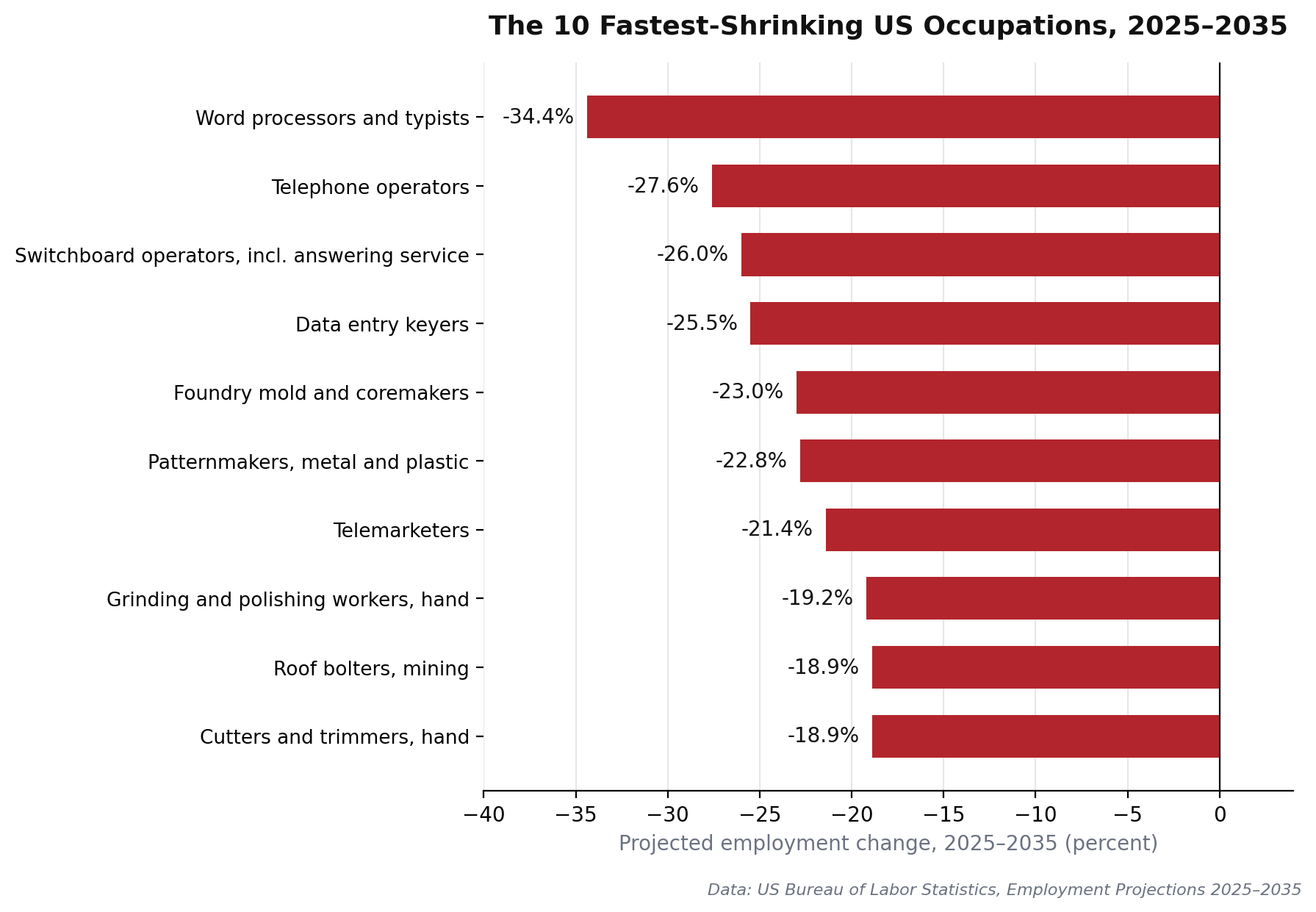
By percentage, word processors and typists is projected to be the fastest-shrinking detailed occupation in the country, falling 34.4 percent to just 26,500 workers by 2035, according to the BLS fastest-declining occupations table. Telephone operators (-27.6 percent) and switchboard operators (-26.0 percent) follow, both occupations that have been shrinking for decades as automated systems replace manual call routing.
Data: US Bureau of Labor Statistics, Employment Projections 2025–2035
Data entry keyers round out the top four fastest-declining roles, projected to fall 25.5 percent to 98,200 workers. Several skilled manufacturing trades also appear among the fastest-shrinking occupations, including foundry mold and coremakers (-23.0 percent) and metal and plastic patternmakers (-22.8 percent), reflecting the continued adoption of automated machinery on factory floors.
Cashiers face the largest numeric loss
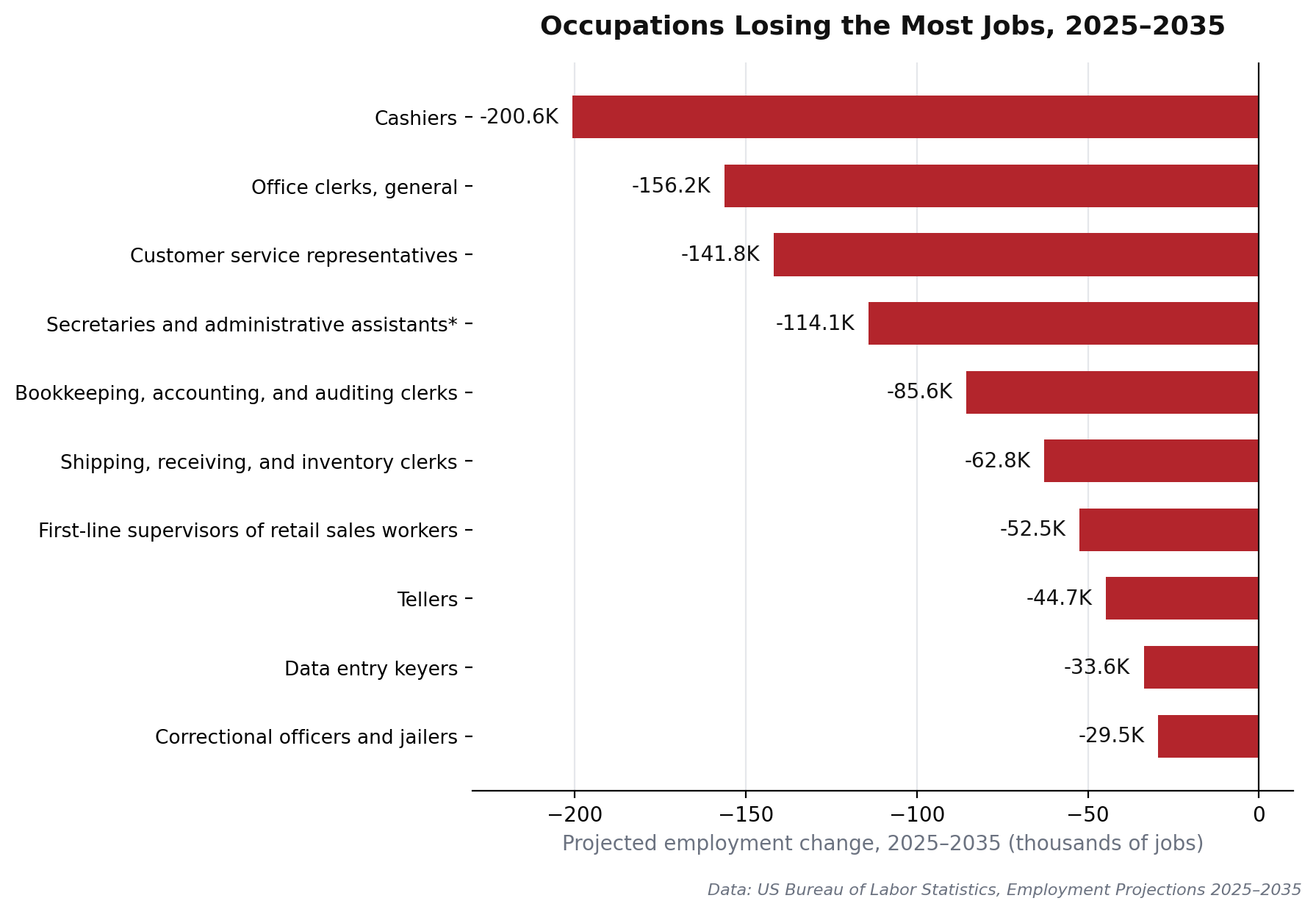
Measured by raw headcount rather than percentage, cashiers is projected to lose the most jobs of any US occupation, down 200,600 positions by 2035, a 6.5 percent decline from an employment base of more than 3.1 million in 2025, according to the BLS table of occupations with the largest job declines. BLS attributes continued softness in retail trade employment, projected to decline 0.2 percent overall, to the growing volume of online purchases displacing in-store transactions.
Data: US Bureau of Labor Statistics, Employment Projections 2025–2035
Office clerks, general is projected to lose 156,200 jobs, and customer service representatives 141,800 jobs, both large occupations where a small percentage decline still translates into a substantial number of workers. Secretaries and administrative assistants except legal, medical, and executive (-114,100 jobs) and bookkeeping, accounting, and auditing clerks (-85,600 jobs) round out the five occupations losing the most positions in absolute terms.
Federal government and retail trade are the only shrinking major industries
At the industry level, only two of the 21 major sectors BLS tracks are projected to shrink over the decade: federal government employment, down 3.4 percent, and retail trade, down 0.2 percent. Manufacturing, by contrast, is projected to grow only slightly, 0.6 percent, reflecting continued deployment of automated machinery and processes that BLS says will reduce labor needs across production occupations even as overall industry output holds roughly steady.
BLS has published a video summary of the 2025–2035 projections covering the occupations and industries driving change across the economy, growth and decline alike.
The agency cautions that these figures describe long-term structural trends under a specific set of assumptions, not a certainty. Workers in a declining occupation are not guaranteed to lose their jobs; BLS projects net changes in total employment, which reflects both new hiring and separations across an occupation, not the fate of any individual worker. Full detail on each occupation, including education requirements and typical training paths into related fields, is available in the BLS Occupational Outlook Handbook.
(Photo: Image by Feygrace from Pixabay)