



The US economy is projected to add 5.9 million jobs between 2025 and 2035, growing 3.5 percent overall, according to new employment projections released by the US Bureau of Labor Statistics (BLS). Total employment is expected to rise from 170.3 million to 176.2 million over the decade, a slower pace than the 10.9 percent growth recorded between 2015 and 2025.
Healthcare is doing most of the work. The private healthcare and social assistance sector alone is projected to add more than 2.2 million jobs, accounting for roughly 37 percent of all new US employment through 2035, according to the BLS Employment Projections 2025–2035 news release. Two healthcare occupational groups, healthcare support and healthcare practitioners and technical, are projected to grow 13.3 percent and 8.0 percent respectively, the fastest of the 22 major occupational groups BLS tracks, and together account for almost a third of all new jobs created through 2035.
BLS projects 5.9 million new jobs by 2035 — and healthcare alone claims more than a third of them.
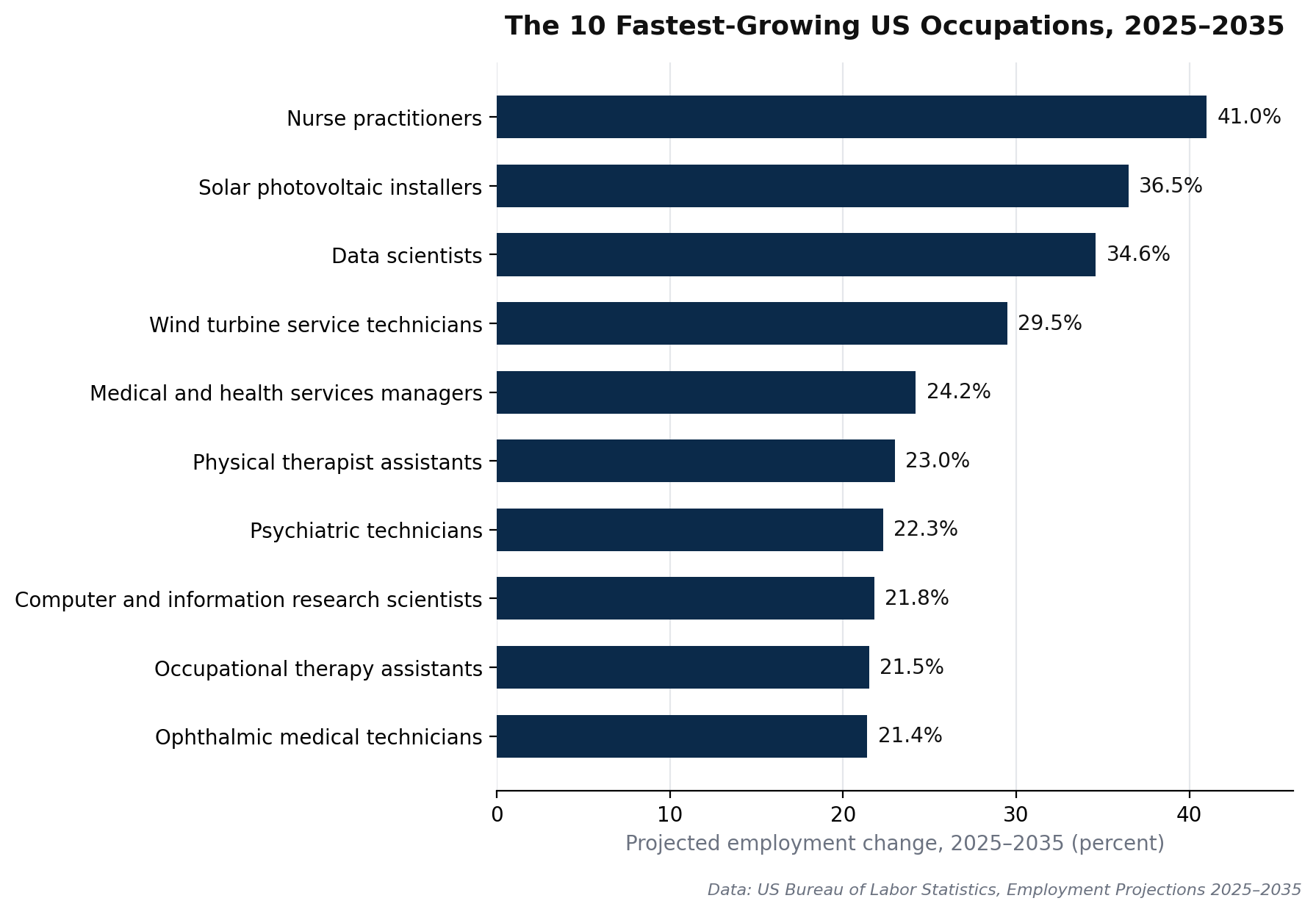
Nurse practitioners lead every detailed occupation
Nurse practitioners is projected to be the single fastest-growing detailed occupation in the country, expanding 41.0 percent and adding 137,800 positions by 2035, according to the BLS fastest-growing occupations table. The median annual wage for the occupation was $132,300 in 2025.
Data: US Bureau of Labor Statistics, Employment Projections 2025–2035
Emily Krutsch, chief of BLS’s Division of Employment Projections, told CNBC that the surge in healthcare hiring traces back to the aging US population and the rising prevalence of chronic conditions and behavioral health disorders, including heart disease, cancer, and diabetes, all of which raise long-term demand for care.
Six of the 10 fastest-growing detailed occupations by percentage are in healthcare: nurse practitioners, medical and health services managers (24.2 percent, 155,100 jobs, $123,860 median wage), physical therapist assistants (23.0 percent), psychiatric technicians (22.3 percent), occupational therapy assistants (21.5 percent), and ophthalmic medical technicians (21.4 percent). Rounding out the top 10 are data scientists (34.6 percent, 95,400 jobs, $120,230 median wage), solar photovoltaic installers (36.5 percent), wind turbine service technicians (29.5 percent), and computer and information research scientists (21.8 percent).
Where the jobs actually are
Fast percentage growth and large numeric growth are not the same thing. Solar photovoltaic installers and wind turbine service technicians are growing quickly in relative terms, but both occupations combined are projected to add fewer than 15,000 jobs nationwide by 2035, because they start from a small employment base.
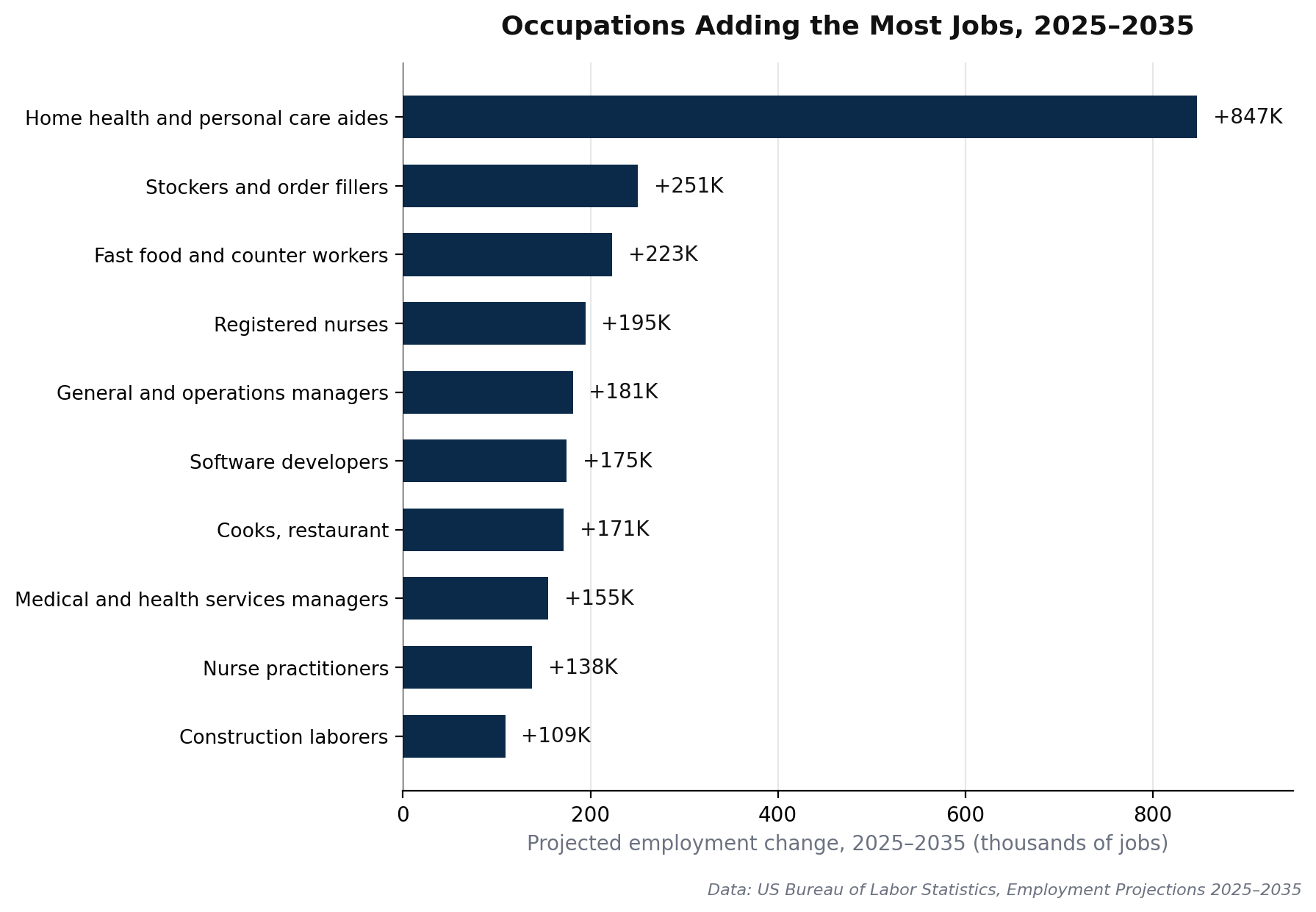
By sheer headcount, the story looks different. Home health and personal care aides is projected to add 847,300 jobs by 2035, more than any other detailed occupation, driven by demand for home-based care for the elderly and people with disabilities, according to the BLS table of occupations with the most job growth. Stockers and order fillers (250,700 jobs), fast food and counter workers (223,300 jobs), and registered nurses (194,700 jobs, $97,550 median wage) round out the occupations adding the largest number of positions.
Data: US Bureau of Labor Statistics, Employment Projections 2025–2035
Software developers stand out as the clearest technology-sector entry in the numeric rankings, projected to add 174,700 jobs (a 10.2 percent increase) at a $135,980 median wage, reflecting continued demand for digital tools and artificial intelligence applications across the economy.
The industries pulling the growth
At the industry level, utilities is projected to grow faster than any other major sector (9.8 percent) through 2035, though its small size means that translates to only about 58,800 new jobs, most of it in electric power generation to meet rising demand, including from AI infrastructure. Professional, scientific, and technical services is projected to grow 8.6 percent and add 926,700 jobs, driven in large part by demand for AI systems, research and development, and related consulting.
Among detailed industries, solar, wind, and geothermal electric power generation are projected to be the fastest-growing in percentage terms, and the computing infrastructure, data processing, and web hosting industry is projected to grow 25.1 percent and add 120,400 jobs as AI adoption accelerates.
Not every sector is expanding. Federal government employment is projected to decline 3.4 percent and retail trade 0.2 percent over the decade, continuing trends BLS has tracked in prior projection cycles.
BLS has published a video summary of the 2025–2035 projections, covering the fastest-growing occupations, the occupations adding the most jobs, and the industries driving the change.
BLS cautions that the projections describe what would be expected to happen under a specific set of assumptions about the labor force, the macroeconomy, and technological progress in line with historical patterns, not a firm forecast. The agency’s full Occupational Outlook Handbook, covering roughly 600 detailed occupations, updates with the new 2025–2035 figures alongside wage, education, and training data for each one.
(Photo: Image by sasint from Pixabay)