


Young Workers’ Jobless Rate Rises as Skilled Trades Stay Hard to Fill
US employers added 29,000 jobs in September 2026, the Bureau of Labor Statistics reported on October 2, 2026. The figure was below the 90,000 forecast by economists polled by LSEG (LSE: LSEG), according to Fox Business. The unemployment rate, which the bureau described as little changed, was 4.2 percent in September, compared with 4.1 percent in August. July and August payrolls were revised down by a combined 60,000 jobs. July now shows a net loss of 10,000 jobs, and August’s gain was cut from 162,000 to 133,000.
Private employers added 46,000 jobs while government payrolls fell by 17,000, according to the bureau’s report. Trade, transportation and utilities added 18,000 jobs, health care 17,000, construction 11,000, leisure and hospitality 10,000 and manufacturing 9,000. The information sector lost 10,000 jobs, professional and business services 9,000 and financial activities 7,000. The bureau described employment in each of these industries except health care as little changed over the month. The bureau said financial activities employment is down 129,000 from a recent peak in May 2025, with most of the job loss in insurance carriers and related activities.
Average hourly earnings for private-sector workers rose 5 cents to $37.81 USD, a 3.0 percent gain over 12 months, according to the bureau’s September jobs report. The Consumer Price Index rose 3.4 percent in the 12 months through August 2026, with energy prices up 16.3 percent, while prices excluding food and energy rose 2.4 percent, according to the bureau’s September 11, 2026, inflation report. According to PBS NewsHour, annual wage growth has slipped to its lowest level since May 2021.
Job Openings, Hiring and Layoffs
The bureau’s Job Openings and Labor Turnover Survey, released September 29, 2026, counted 7.1 million job openings in August, a level the bureau described as little changed, and 5.2 million hires, for a hiring rate of 3.3 percent. Layoffs and discharges totaled 1.6 million, a rate of 1.0 percent, and quits held at 3.1 million, or 1.9 percent of employment. The US Department of Labor reported an advance figure of 197,000 seasonally adjusted initial unemployment claims for the week ending October 3, 2026, and the four-week average stood at 198,000.
Of the 7.1 million unemployed people in September, 1.9 million had been jobless for 27 weeks or longer, or 27.1 percent of the total, according to the bureau’s September jobs report. The median spell of unemployment was 11.5 weeks, up from 10.1 weeks a year earlier.
Minutes of the Federal Open Market Committee meeting of September 15-16, 2026, which was held before the jobs report, recorded that a majority of participants “assessed that the labor market had strengthened a bit recently,” while several participants noted that “dynamism in the labor market was unusually low, as reflected by low rates of hiring and layoffs, a low job-finding rate, and a persistently elevated long-term unemployment rate.”
Adam Schickling, senior economist at Vanguard, said, according to Fox Business: “Hiring is subdued, layoffs remain remarkably low, and month-to-month payroll figures are likely to keep sending mixed signals. The underlying story is still a low-hire, low-fire labor market.”
Fed Officials Point to Inflation
Beth Hammack, president of the Federal Reserve Bank of Cleveland, told PBS NewsHour on the day of the release that she does not “make too much of any one individual report.” She said job creation has averaged 41,000 a month over the past year, roughly her estimate of the break-even pace, and called the unemployment rate “the single best measure of the health of the labor market.” The bureau put the average monthly gain over the 12 months before September at 45,000.
Hammack said her concern lies with prices: “We have been missing on our inflation mandate for more than 5.5 years, and it’s really important that we’re able to bring inflation back down to our 2 percent objective.” She described what she calls an “inflationary mindset,” citing a retailer in her district that now raises prices by more than its rising input costs because it expects more inflation to come.
The Federal Reserve raised its benchmark rate by a quarter point to a range of 3.75 percent to 4 percent on September 16, 2026, by a 12-0 vote, stating that “job gains have kept pace with the workforce, and the unemployment rate has changed little.” Federal Reserve Chairman Kevin Warsh said at his press conference that “the plain fact is that inflation is too high and has been for too long.” The median projection of committee participants puts total inflation, as measured by personal consumption expenditures, at 3.7 percent this year. Warsh said he did not submit a projection of his own.
After the jobs report, the FedWatch tool from CME Group (NASDAQ: CME) showed a 79.5 percent probability that the committee would leave rates unchanged at its October 27-28, 2026, meeting, up from 75.6 percent a day earlier and 35.8 percent a week earlier, and a 66.2 percent chance of a quarter-point increase in December, according to Fox Business. Phil Camporeale, chief investment strategist at J.P. Morgan Wealth Management, a unit of JPMorgan Chase (NYSE: JPM), said the “combination of lower-than-expected jobs created, negative revisions to prior data and weaker wage growth are further evidence that the labor market is not a source of inflationary pressure,” according to Fox Business. The 10-year Treasury par yield was 5.28 percent on the day of the report, up from 5.24 percent a day earlier, according to US Department of the Treasury data.
Lower-Income Households Lean on Credit, Hammack Says
Hammack said a roundtable with low- and moderate-income workers in Northeast Ohio showed how wages trailing inflation affect household budgets. She said participants told her that six months ago they had been trading down from steak to ground beef to beans and pasta. Now, she said, they are deciding which bills to pay and are relying on credit “a bit more than they had.”
“Now they’re not trading down anymore. They’re choosing which bills they’re paying.”
— Beth Hammack, president of the Federal Reserve Bank of Cleveland
Jobless Rate for Workers Ages 20 to 24 Rises to 8 Percent
Unemployment among workers ages 20 to 24 rose to 8.0 percent in September from 7.1 percent in August, though it remains below the 9.2 percent recorded in September 2025, according to the bureau’s September jobs report. Unemployment among teens ages 16 to 19 stood at 14.5 percent. Unemployment among workers ages 25 and older holding a bachelor’s degree or higher was 2.5 percent in September.
The Federal Reserve Bank of New York reported that unemployment among recent college graduates ages 22 to 27 “stayed elevated at about 5.6 percent” in the second quarter of 2026, and that the share of them working in jobs that typically do not require a college degree edged up to 42 percent.
The National Association of Colleges and Employers reported in April 2026 that the median employer expected to hire 5.6 percent more graduates from the class of 2026, following what it called “two years of lackluster job markets for new college graduates.”
Federal Reserve Governor Michael Barr said in a February 17, 2026, speech that research so far suggests that “while AI has yet to have a substantial effect on aggregate employment or unemployment, it may be starting to adversely affect some groups, in particular young people who are just starting their careers in some sectors.” He cited a study using payroll data from ADP (NASDAQ: ADP) that found “early-career workers in occupations highly exposed to AI—such as software developers and customer service representatives—have experienced a decline in employment relative to other early-career workers in less exposed fields and experienced workers in the same line of work.” Barr said the evidence so far is consistent with a scenario of gradual AI adoption. Discussing an alternative scenario of rapid adoption, he said: “We should be clear-eyed about how painful these changes could be for affected workers and how challenging it would be for the government and the private sector to successfully manage the fallout.” EmpleoBilingue reported in September on where AI exposure and projected job losses overlap in the bureau’s occupational data.
Unemployment Among Hispanic and Black Workers
Unemployment among Hispanic workers fell to 4.7 percent in September 2026 from 5.5 percent a year earlier, while the overall rate fell from 4.4 percent to 4.2 percent over the same period, according to the bureau’s September jobs report. The labor force participation rate for the Hispanic or Latino population ages 16 and older was 68.1 percent, compared with 61.8 percent for the population as a whole, and Hispanic employment totaled 34.4 million in September. Unemployment among Black workers rose to 7.0 percent in September from 6.0 percent in August, compared with 7.6 percent a year earlier.
Employers Report Shortages in Skilled Trades
Hammack said employers in the Cleveland Fed’s Fourth District, which covers Ohio, western Pennsylvania, eastern Kentucky and part of West Virginia, report difficulty finding workers in the skilled trades. She said data center construction has made electricians “really hard to come by,” and that housing projects need the same workers. The higher cost of hiring those trades, she said, has pushed prices up across the board.
The Federal Reserve’s August 2026 Beige Book, published September 2, 2026, reported that employment “rose very slightly overall” and that “skilled trades and technical workers were difficult to find.” It said districts reported “both positive and negative effects of artificial intelligence on labor demand,” and that “significant wage increases were most often connected to demand for skilled workers in construction and manufacturing.” Some participants at the September committee meeting observed that “strong demand for skilled workers in sectors related to the ongoing AI buildout had been driving strong wage gains for these workers,” according to the minutes.
The bureau projects employment of electricians to grow 9 percent from 2025 to 2035, with about 72,700 openings each year. Electricians had a median annual wage of $63,190 USD in May 2025. They typically need a high school diploma and complete a paid apprenticeship of four to five years.
The Bureau of Labor Statistics is scheduled to publish the October 2026 jobs report on November 6, 2026, nine days after the committee’s October 27-28 meeting.
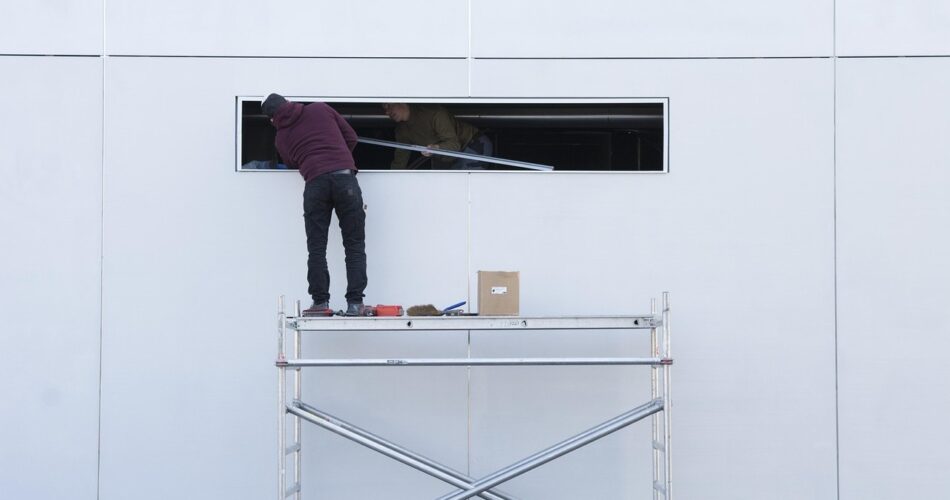
Headline photo: Workers on a mobile scaffold install a panel on a building facade. (Photo: Image by JayHugh from Pixabay)