



Alongside its 2025–2035 employment projections, the US Bureau of Labor Statistics (BLS) released a new data product for the first time this year: a set of four categories, ranging from low to very high, that score every detailed US occupation by its relative exposure to artificial intelligence. The agency combined five external research sources, three theoretical measures of what AI could plausibly do and two measures of observed AI usage from Anthropic‘s Claude and Microsoft Copilot data, to sort 831 occupations into the categories, according to the BLS AI exposure categories methodology page.
BLS is explicit that the categories are not a forecast. A “very high” exposure rating does not mean an occupation’s employment will fall, and a “low” rating does not mean an occupation is safe from future technological change. The measure describes how much of an occupation’s tasks could theoretically be completed or assisted by AI, and how often AI systems have been observed touching similar work, not whether that will translate into fewer jobs.
Crossing that new exposure data against BLS’s own separate 2025–2035 employment projections shows where the two signals actually line up: large occupations that BLS rates “very high” for AI exposure and that the agency also projects will shrink over the coming decade.
BLS’s new AI exposure scores aren’t a forecast — but cross them with its own job data and a pattern emerges.
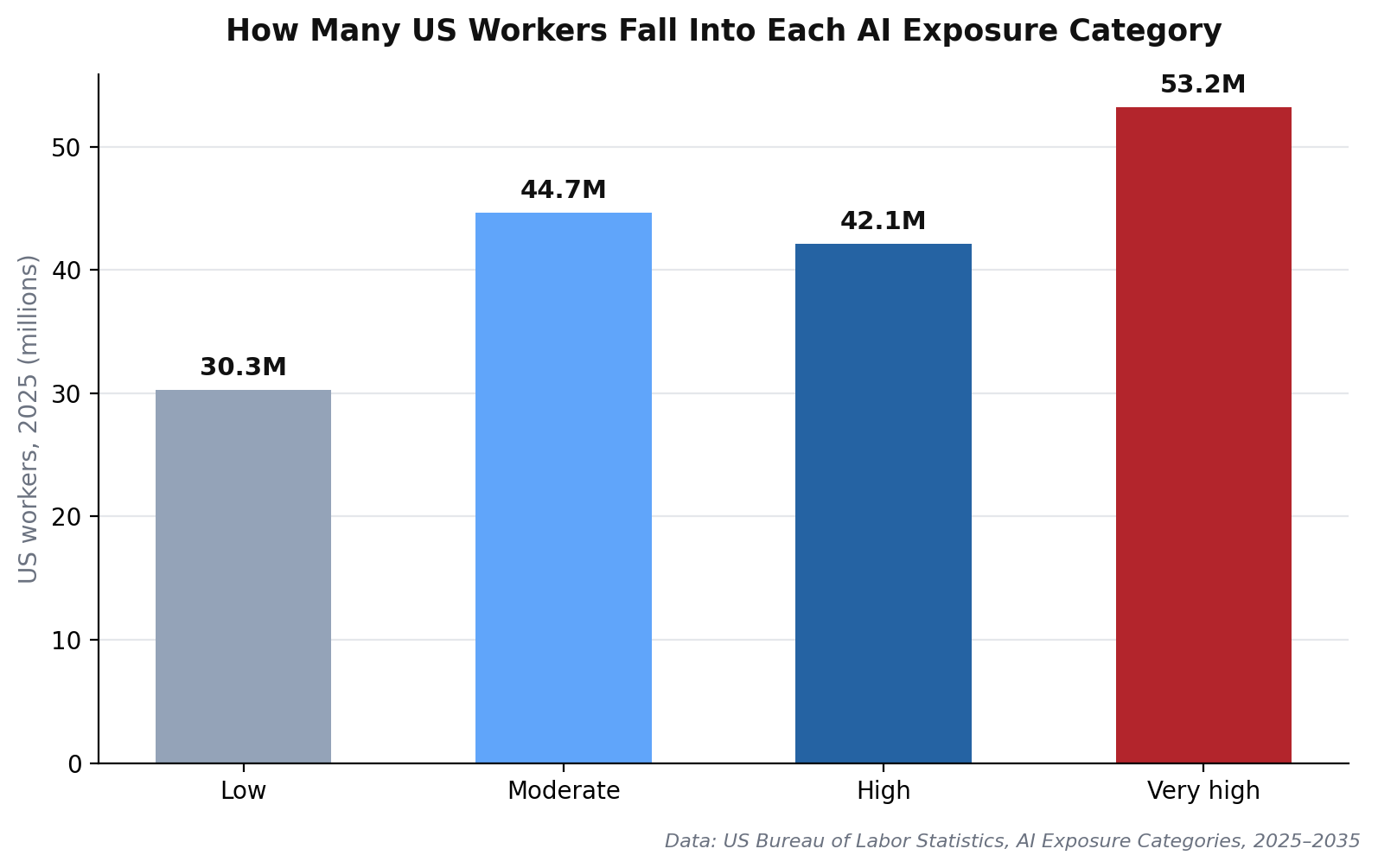
53 million workers are in “very high” exposure jobs
BLS placed roughly 53.2 million of the 170.3 million US workers employed in 2025, about 31 percent of the workforce, in occupations it rates “very high” for AI exposure, according to BLS’s own AI exposure categories dataset. Another 42.1 million workers are in “high” exposure occupations, 44.7 million in “moderate,” and 30.3 million in “low.”
Data: US Bureau of Labor Statistics, AI Exposure Categories, 2025–2035
The largest occupations rated “very high” span retail salespersons, customer service representatives, office clerks, secretaries and administrative assistants, software developers, and accountants and auditors, according to the BLS dataset. Several of the largest “very high” occupations, including software developers and accountants and auditors, are projected to keep growing through 2035, underscoring the agency’s caution that exposure alone does not predict a decline.
Where exposure and projected decline overlap
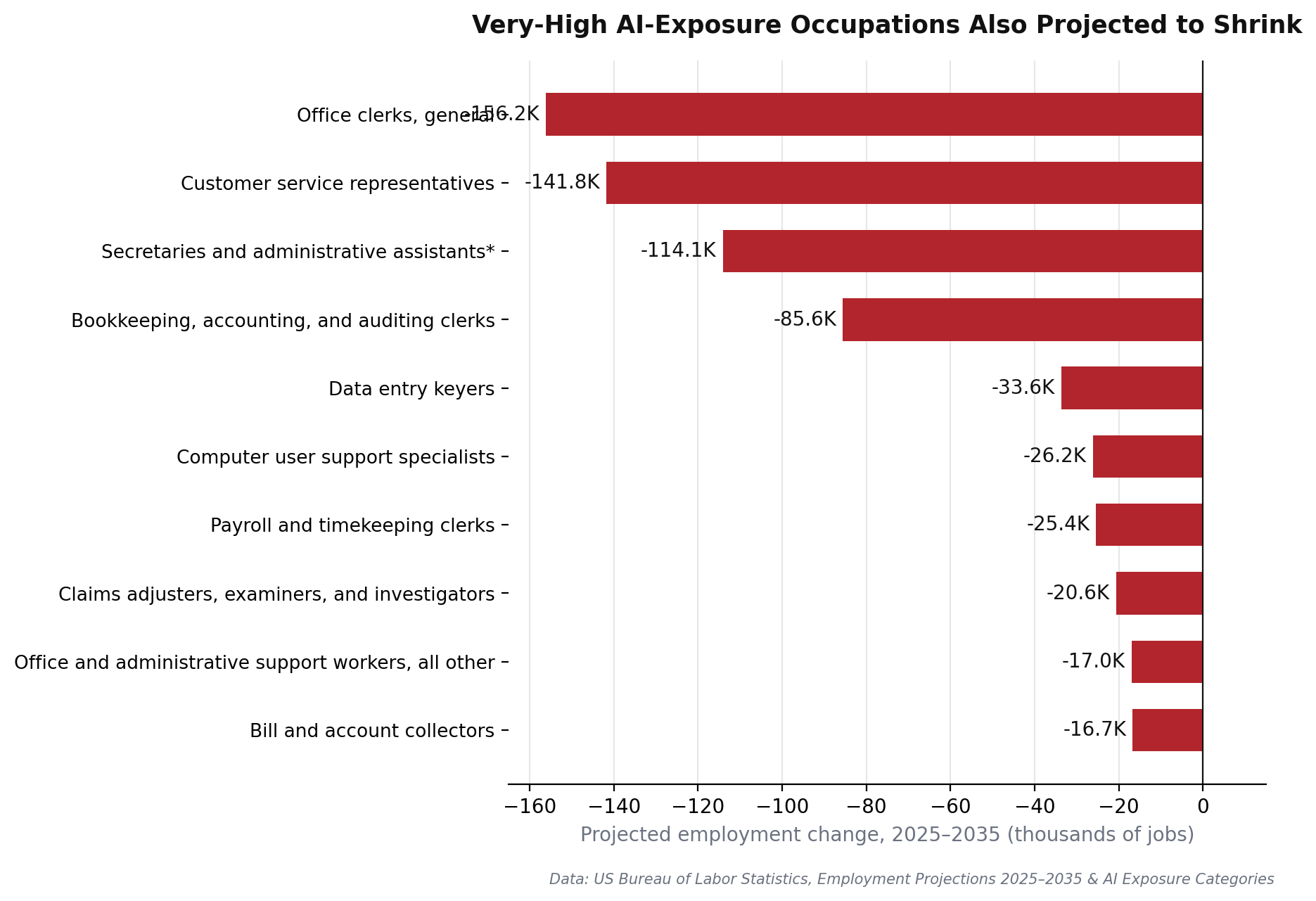
60 detailed occupations rated “very high” for AI exposure are also projected to lose jobs over the 2025–2035 decade, together accounting for a net loss of about 862,500 positions, according to BLS’s employment projections data. The pattern concentrates heavily in office and administrative work, the same occupational group BLS separately projects will shrink faster than any other in the economy.
Data: US Bureau of Labor Statistics, Employment Projections 2025–2035 & AI Exposure Categories
Office clerks, general lead the list, rated “very high” exposure and projected to lose 156,200 jobs (-6.0 percent) by 2035. Customer service representatives (-141,800 jobs), secretaries and administrative assistants except legal, medical, and executive (-114,100 jobs), and bookkeeping, accounting, and auditing clerks (-85,600 jobs) follow. Data entry keyers combine one of the steepest percentage declines in the entire occupational structure, -25.5 percent, with a “very high” exposure rating.
Outside clerical work, computer user support specialists (-26,200 jobs) and network and computer systems administrators (-13,200 jobs) are both rated “very high” exposure and projected to shrink, extending the pattern into some of the same technical-support roles, though BLS does not attribute either decline specifically to AI adoption.
What BLS says this does and does not mean
BLS’s own limitations section on the exposure data is blunt: an exposure category is not a wage forecast, not an estimate of the probability that a business adopts AI, not a worker-replacement estimate, and not a productivity forecast. The theoretical measures behind the ratings are based on AI capabilities as they stood no later than mid-2023, and the observed-usage measures may lean toward early adopters of specific AI tools, meaning the categories describe a snapshot rather than where AI capability stands today.
The agency’s broader technical note on the 2025–2035 projections adds that historically, technology has changed occupations gradually rather than suddenly, and that even rapid technological advances take time for employers and workers to fold into daily practice. BLS says it applies research on emerging technologies like AI conservatively in its projections, adjusting only where there is convincing evidence of a lasting structural shift.
BLS has published a video summary of the 2025–2035 projections covering the occupations and industries the agency expects to grow and shrink over the coming decade.
The full AI exposure dataset, covering all 831 detailed occupations for which BLS produces projections, is available for download from the agency, alongside the Occupational Outlook Handbook profiles for each one.
(Photo: Image by jarmoluk from Pixabay)